

Which Protist Group Is Thought To Be Most Closely Related To Animals?
What are protists?
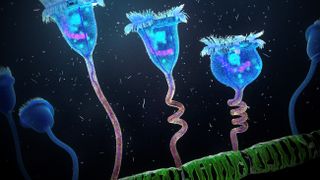
Protists are a diverse collection of organisms that practice not fit into animal, institute, leaner or fungi groups. While exceptions exist, they are primarily microscopic and fabricated up of a single cell (unicellular), according to the educational website CK-12.
Protists are eukaryotes as they possess a nucleus and other membrane-jump organelles (structures that perform a specific job).
At in one case, uncomplicated organisms such as amoebas and single-celled algae were classified together in a single taxonomic category: the kingdom Protista. However, the emergence of better genetic data has since led to a clearer understanding of evolutionary relationships amid dissimilar groups of protists, and this classification system was rendered defunct. Understanding protists and their evolutionary history continues to be a matter of scientific discovery and give-and-take.
Characteristics of protists
All living organisms can be broadly divided into two groups — prokaryotes and eukaryotes — which are distinguished by the relative complexity of their cells. In contrast to prokaryotic cells, eukaryotic cells are highly organized. Leaner and archaea are prokaryotes, while all other living organisms — protists, plants, animals and fungi — are eukaryotes, according to the educational website tutors.com.
Many diverse organisms including algae, amoebas, ciliates (such every bit paramecium) fit the general moniker of protist. "The simplest definition is that protists are all the eukaryotic organisms that are not animals, plants or fungi," said Alastair Simpson, a professor in the section of biology at Dalhousie University. The vast majority of protists are unicellular or form colonies consisting of 1 or a couple of distinct kinds of cells, according to Simpson. He further explained that there are examples of multicellular protists among brown algae and certain cherry-red algae.
Protist cells
Like all eukaryotic cells, protists have a characteristic central compartment called the nucleus, which houses their genetic material. They also have specialized cellular machinery called organelles that execute defined functions within the cell. Photosynthetic protists such as the various types of algae contain plastids. These organelles serve equally the site of photosynthesis (the process of harvesting sunlight to produce nutrients in the form of carbohydrates). The plastids of some protists are like to those of plants. Co-ordinate to Simpson, other protists have plastids that differ in the color, the repertoire of photosynthetic pigments and even the number of membranes that enclose the organelle, as in the case of diatoms and dinoflagellates, which constitute phytoplankton in the ocean.
Near protists have mitochondria, the organelle which generates energy for cells to use. The exceptions are some protists that alive in anoxic conditions, or environments defective in oxygen, according to Astrobiology at NASA. They use an organelle called the hydrogenosome (which is a greatly modified version of mitochondria) for some of their energy production. For example, the sexually transmitted parasite Trichomonas vaginalis, which infects the human vagina and causes trichomoniasis, contains hydrogenosomes.
Related: Robert Hooke: English scientist who discovered the cell
Protist feeding habits
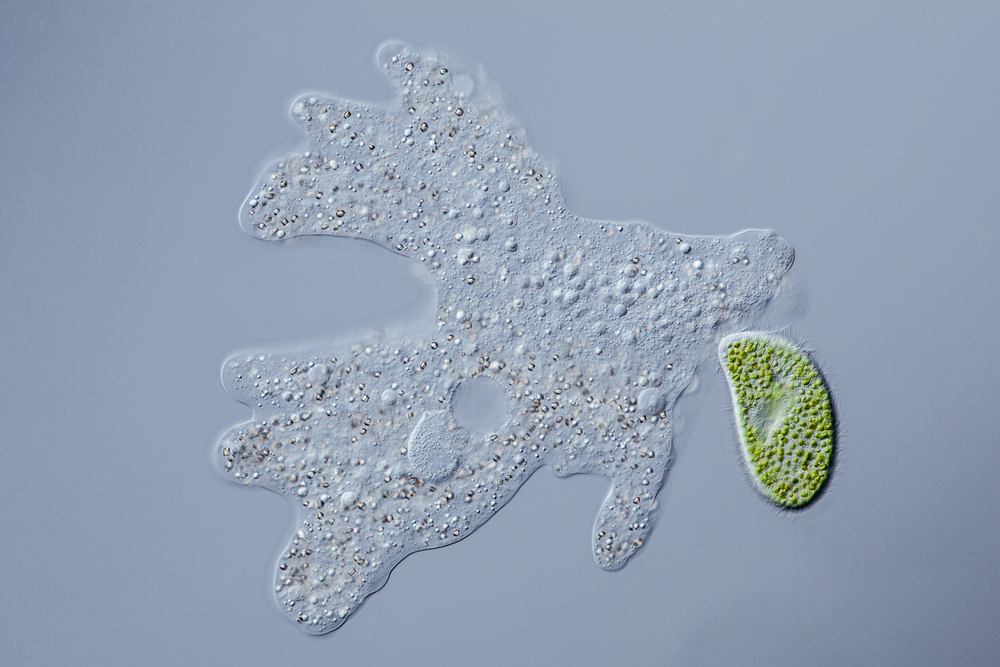
Protists gain diet in a number of means. According to Simpson, protists tin be photosynthetic or heterotrophs (organisms that seek exterior sources of food in the form of organic textile). In turn, heterotrophic protists fall into ii categories: phagotrophs and osmotrophs. Phagotrophs apply their cell trunk to surround and swallow up food, often other cells, while osmotrophs absorb nutrients from the surrounding surroundings. "Quite a few of the photosynthetic forms are also phagotrophic," Simpson told Live Science. "This is probably true of nearly 'algal' dinoflagellates for example. They have their ain plastids, but volition also happily consume other organisms." Such organisms are called mixotrophs, reflecting the mixed nature of their nutritional habits.
Protist reproduction
Most protists reproduce primarily through asexual mechanisms according to Simpson. This can include binary fission, where a parent prison cell splits into 2 identical cells or multiple fission, where the parent cell gives rising to multiple identical cells. Simpson added that most protists probably also take some kind of sexual bicycle, however, this is but well documented in some groups.
Classification: from Protozoa to Protista and beyond
The classification history of protists traces our agreement of these diverse organisms. Often complex, the long history of protist classification introduced two terms, even so used today, into the scientific lexicon: protozoa and protists. Even so, the meaning of these terms has besides evolved over time.
The observable living world was in one case neatly divided between plants and animals. But the discovery of diverse microscopic organisms (including what we now know equally protists and bacteria) brought forth the need to empathize what they were, and where they fit taxonomically.
The showtime instinct of scientists was to relate these organisms to plants and animals by relying on morphological characteristics. The term protozoan (plural: protozoa or protozoans), meaning "early animals," was introduced in 1820 by naturalist Georg A. Goldfuss, according to a 1999 article published in the journal International Microbiology. This term was used to draw a drove of organisms including ciliates and corals. By 1845, Protozoa was established every bit a phylum or subset of the animal kingdom past German language scientist Carl Theodor von Seibold. This phylum included certain ciliates and amoebas, which were described by von Seibold as unmarried-celled animals. In 1860, the concept of protozoans was further refined and they were elevated to the level of a taxonomic kingdom by paleontologist Richard Owen. The members of this Kingdom Protozoa, in Owen'south view, had characteristics mutual to both plants and animals.
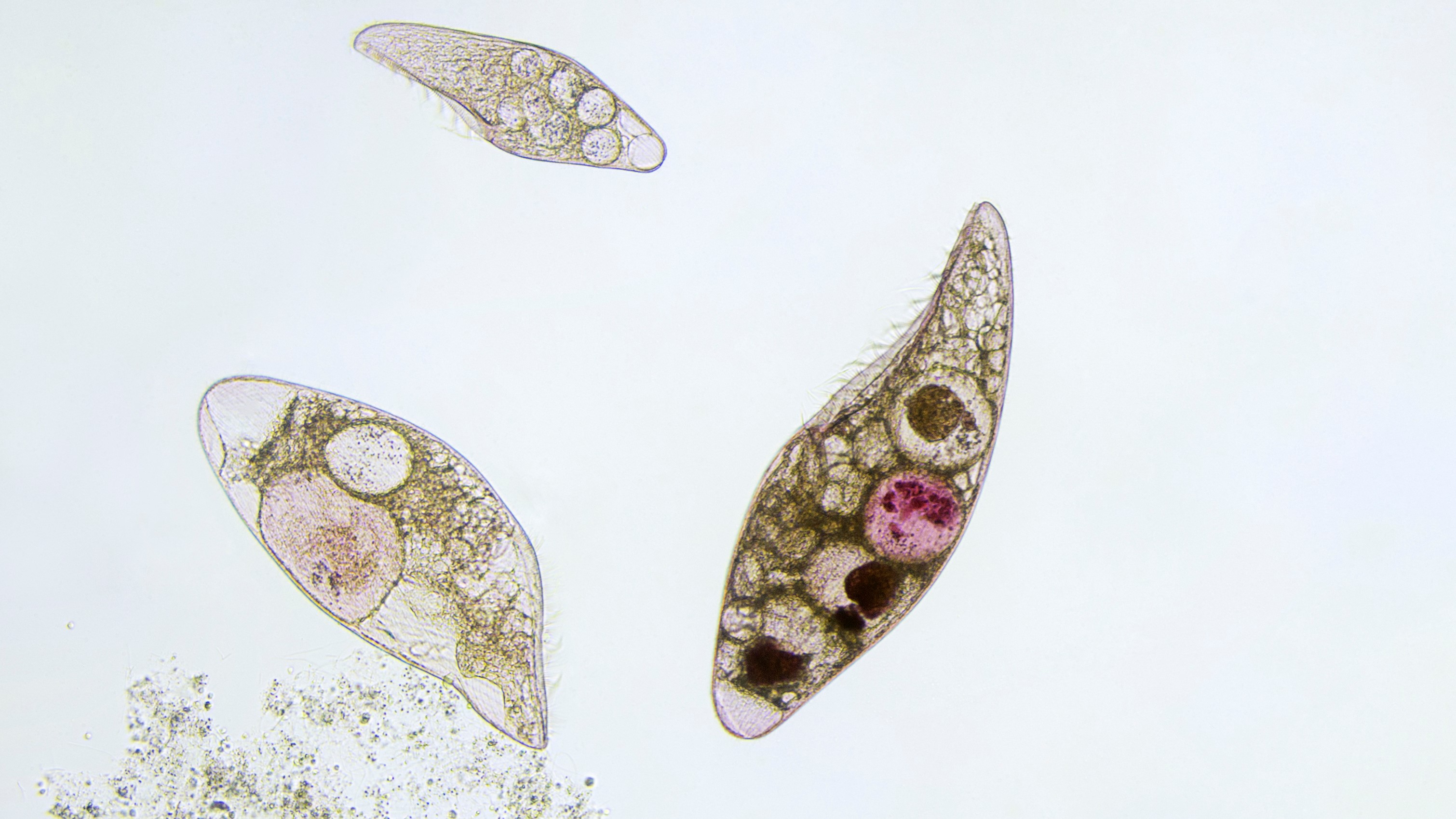
Though the scientific rationale behind each of these classifications implied that protozoans were rudimentary versions of plants and animals, at that place was no scientific prove of the evolutionary relationships between these organisms (International Microbiology, 1999). According to Simpson, present "protozoa" is a term of convenience used in reference to a subset of protists, and is not a taxonomic grouping. "In club to exist called a protozoan, they [protists] have to be non-photosynthetic and non very mucus-similar," Simpson told Live Science.
The term protista, meaning "the first of all or primordial" was introduced in 1866 by German scientist Ernst Haeckel. He suggested Protista every bit a tertiary taxonomic kingdom, in addition to Plantae and Animalia, consisting of all "primitive forms" of organisms, including bacteria (International Microbiology, 1999).
Since so, the kingdom Protista has been refined and redefined many times. Different organisms moved in and out (notably, leaner moved into a taxonomic kingdom of their own). American scientist John Corliss proposed i of the modern iterations of Protista in the 1980s. His version included the multicellular red and brown algae, which are considered to be protists fifty-fifty today.
Scientists, often concurrently, have debated kingdom names and which organisms were eligible (for case, versions of yet another kingdom, Protoctista had been proposed over the years). Even so, it is important to note the lack of correlation between taxonomy and evolutionary relationships in these groupings. Co-ordinate to Simpson, these groupings were not monophyletic, significant that they did not represent a single, whole co-operative of the tree of life; that is, an ancestor and all of its descendants.
Today's classification has shifted away from a arrangement built on morphology to one based on genetic similarities and differences. The consequence is a family tree of sorts, mapping out evolutionary relationships between various organisms. In this system, there are three main branches or "domains" of life: Bacteria, Archaea (both prokaryotic) and Eukarya (the eukaryotes).
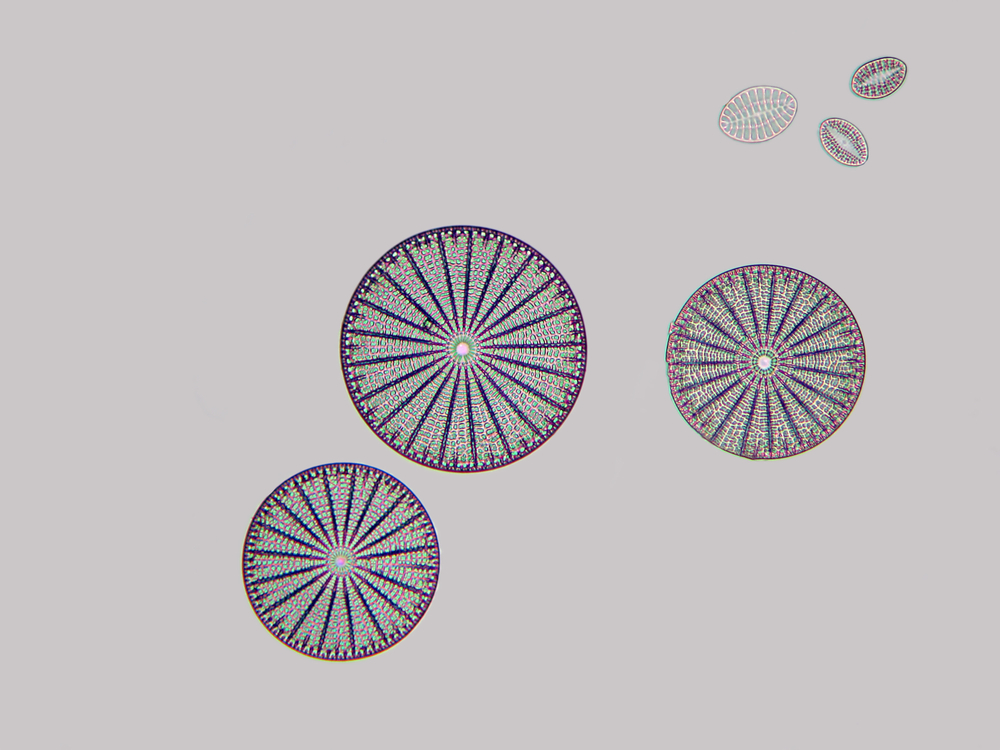
Inside the eukaryotic domain, the protists are no longer a single group. They accept been redistributed among unlike branches of the family unit tree. According to Simpson, nosotros now know nearly of the evolutionary relationships amidst protists, and these are often counterintuitive. He cited the example of dinoflagellate algae, which are more than closely related to the malaria parasite than they are to diatoms (another grouping of algae) or even to land plants.
Withal, at that place are pressing questions that remain. "We simply don't know what the earliest split was among the lineages that led to living eukaryotes," Simpson told Alive Science. This indicate is called the "root" of the eukaryotic tree of life. Pinpointing the root volition cement the understanding of eukaryotic origins and their subsequent evolution. As author Tom Williams said in a 2014 article published in the journal Electric current Biology, "For the eukaryotic tree, the root position is disquisitional for identifying the genes and traits that may have been present in the ancestral eukaryote, for tracing the evolution of these traits throughout the eukaryotic radiations, and for establishing the deep relationships among the major eukaryotic groups."
The importance of protists
are responsible for a variety of human being diseases including malaria, sleeping sickness, amoebic dysentery and trichomoniasis. Malaria in humans is a devastating affliction. It is acquired past five species of the parasite Plasmodium, which are transmitted to humans by female person Anopheles mosquitoes, according to the Centers for Affliction Command and Prevention (CDC). The species Plasmodium falciparum infects crimson claret cells, multiplies speedily and destroys them. Infection can besides cause cherry claret cells to stick to the walls of small blood vessels. This creates a potentially fatal complication called cerebral malaria (co-ordinate to the CDC).
The World Health System (WHO) states that Plasmodium falciparum is the most prevalent and lethal to humans. Co-ordinate to their recent malaria fact canvass, in 2020 there were an estimated 627,000 deaths due to malaria in the earth, the bulk of which (xc percentage) occurred in Africa. Sure strides take been made in reducing the rates of incidence (occurrence of new cases) and mortality rates in function by supplying insecticide-treated mosquito nets, spraying for mosquitoes and improving diagnostics. According to the WHO "In 2020, 26 countries reported fewer than 100 indigenous cases of the disease, upwardly from half-dozen countries in 2000".The WHO has a goal of eliminating malaria in at least 35 countries by 2030.
Protists also play an of import part in the environs. Co-ordinate to CK-12, plant-like protists produce almost half of the oxygen on Earth through photosynthesis. Protists human activity equally decomposers and assist in recycling nutrients through ecosystems, according to the educational website Biological science Online. In add-on, protists in diverse aquatic environments, including the open up water, waterworks and sewage disposal systems feed upon, and command bacterial populations "If y'all took all the protists out of the earth, the ecosystem would collapse really quickly," Simpson said.
Additional resources
If you would like to learn more about protists check out this informative lesson on the educational website Study.com, you lot can fifty-fifty take a quiz at the end to examination your cognition. Read more almost how protists are beneficial to humans in this article from the science news site AllThingsNature. If you're still wanting more, head over to the educational website Lumen Learning for even more protist content.
Bibliography
- Caron, David A. "Towards a molecular taxonomy for protists: benefits, risks, and applications in plankton ecology." Journal of Eukaryotic Microbiology 60.four (2013): 407-413.
- Xiong, Wu, et al. "Soil protist communities form a dynamic hub in the soil microbiome." The ISME Journal 12.2 (2018): 634-638.
- Foissner, Wilhelm. "Protist diversity and distribution: some basic considerations." Protist diversity and geographical distribution. Springer, Dordrecht, 2007. ane-8.
Source: https://www.livescience.com/54242-protists.html
Posted by: hayneswhospartin1961.blogspot.com
0 Response to "Which Protist Group Is Thought To Be Most Closely Related To Animals?"
Post a Comment