

What Other Animals Live In Their Habitat


Few creatures brand the ice shelves of Antarctica their habitat, but h2o beneath the ice can provide habitat for multiple species.[1]

Ibex in an alpine habitat
In ecology, the term habitat summarises the array of resources, concrete and biotic factors that are present in an area, such as to support the survival and reproduction of a item species. A species habitat can exist seen as the physical manifestation of its ecological niche. Thus "habitat" is a species-specific term, fundamentally different from concepts such as environment or vegetation assemblages, for which the term "habitat-type" is more appropriate.[2]
The physical factors may include (for example): soil, moisture, range of temperature, and low-cal intensity. Biotic factors will include the availability of food and the presence or absence of predators. Every species has particular habitat requirements, with habitat generalist species able to thrive in a wide array of ecology weather while habitat specialist species requiring a very express ready of factors to survive. The habitat of a species is not necessarily found in a geographical surface area, it can be the interior of a stem, a rotten log, a rock or a dodder of moss; a parasitic organism has as its habitat the torso of its host, part of the host's body (such equally the digestive tract), or a single cell within the host's body.[three]
Habitat types are ecology categorizations of different environments based on the characteristics of a given geographical area, particularly vegetation and climate.[4] Thus habitat types practice not refer to a single species only to multiple species living in the aforementioned area. For example, terrestrial habitat types include woods, steppe, grassland, semi-barren or desert. Fresh-water habitat types include marshes, streams, rivers, lakes, and ponds; marine habitat types include salt marshes, the coast, the intertidal zone, estuaries, reefs, trophy, the open ocean, the ocean bed, deep water and submarine vents. Habitat types may change over time. Causes of change may include a vehement result (such equally the eruption of a volcano, an earthquake, a seismic sea wave, a wildfire or a modify in oceanic currents); or modify may occur more than gradually over millennia with alterations in the climate, as ice sheets and glaciers advance and retreat, and every bit different weather patterns bring changes of precipitation and solar radiation. Other changes come equally a direct result of human activities, such as deforestation, the plowing of ancient grasslands, the diversion and damming of rivers, the draining of marshland and the dredging of the seabed. The introduction of alien species can have a devastating effect on native wildlife - through increased predation, through competition for resources or through the introduction of pests and diseases to which the indigenous species have no immunity.
Definition and etymology [edit]
The discussion "habitat" has been in use since near 1755 and derives from the Latin habitāre, to inhabit, from habēre, to have or to hold. Habitat can be defined as the natural environs of an organism, the type of place in which it is natural for it to alive and abound.[5] [6] It is like in meaning to a biotope; an surface area of uniform environmental conditions associated with a item customs of plants and animals.[7]
Ecology factors [edit]
The chief environmental factors affecting the distribution of living organisms are temperature, humidity, climate, soil and light intensity, and the presence or absence of all the requirements that the organism needs to sustain it. Mostly speaking, animal communities are reliant on specific types of constitute communities.[8]
Some plants and animals take habitat requirements which are met in a broad range of locations. The pocket-size white butterfly Pieris rapae for instance is constitute on all the continents of the world apart from Antarctica. Its larvae feed on a wide range of Brassicas and various other plant species, and it thrives in any open up location with various plant associations.[9] The large blueish butterfly Phengaris arion is much more specific in its requirements; it is found just in chalk grassland areas, its larvae feed on Thymus species and because of circuitous lifecycle requirements it inhabits just areas in which Myrmica ants alive.[10]
Disturbance is of import in the creation of biodiverse habitat types. In the absence of disturbance, a climax vegetation cover develops that prevents the establishment of other species. Wildflower meadows are sometimes created by conservationists but nearly of the flowering plants used are either annuals or biennials and disappear after a few years in the absence of patches of bare footing on which their seedlings can grow.[xi] Lightning strikes and toppled trees in tropical forests allow species richness to exist maintained as pioneering species move in to fill the gaps created.[12] Similarly coastal habitat types can become dominated by kelp until the seabed is disturbed past a tempest and the algae swept away, or shifting sediment exposes new areas for colonisation. Another cause of disturbance is when an area may be overwhelmed by an invasive introduced species which is non kept under control by natural enemies in its new habitat.[thirteen]
Types [edit]

Terrestrial habitat types include forests, grasslands, wetlands and deserts. Within these broad biomes are more specific habitat types with varying climate types, temperature regimes, soils, altitudes and vegetation. Many of these habitat types course into each other and each i has its own typical communities of plants and animals. A habitat-type may adjust a particular species well, merely its presence or absence at any particular location depends to some extent on risk, on its dispersal abilities and its efficiency as a colonizer.[14]
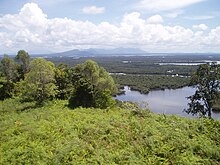
Wetland habitat types in Borneo
Freshwater habitat types include rivers, streams, lakes, ponds, marshes and bogs.[xv] Although some organisms are constitute across most of these habitat types, the bulk have more specific requirements. The water velocity, its temperature and oxygen saturation are important factors, but in river systems, there are fast and slow sections, pools, bayous and backwaters which provide a range of habitat types. Similarly, aquatic plants can be floating, semi-submerged, submerged or grow in permanently or temporarily saturated soils as well bodies of h2o. Marginal plants provide important habitat for both invertebrates and vertebrates, and submerged plants provide oxygenation of the water, blot nutrients and play a function in the reduction of pollution.[16]
Marine habitats include brackish water, estuaries, bays, the open up ocean, the intertidal zone, the body of water bed, reefs and deep / shallow water zones.[xv] Further variations include rock pools, sand banks, mudflats, brackish lagoons, sandy and pebbly beaches, and seagrass beds, all supporting their own flora and fauna. The benthic zone or seabed provides a abode for both static organisms, anchored to the substrate, and for a large range of organisms crawling on or burrowing into the surface. Some creatures float among the waves on the surface of the water, or raft on floating debris, others swim at a range of depths, including organisms in the demersal zone close to the seabed, and myriads of organisms migrate with the currents and form the plankton.[17]

A desert is not the kind of habitat that favours the presence of amphibians, with their requirement for water to proceed their skins moist and for the development of their young. Withal, some frogs live in deserts, creating moist habitat types underground and hibernating while conditions are agin. Couch'southward spadefoot toad (Scaphiopus couchii) emerges from its burrow when a downpour occurs and lays its eggs in the transient pools that form; the tadpoles develop with nifty rapidity, sometimes in every bit petty every bit nine days, undergo metamorphosis, and feed voraciously before excavation a burrow of their ain.[18]
Other organisms cope with the drying up of their aqueous habitat in other ways. Vernal pools are ephemeral ponds that form in the rainy flavor and dry upwards afterwards. They have their specially-adapted characteristic flora, mainly consisting of annuals, the seeds of which survive the drought, but besides some uniquely adapted perennials.[19] Animals adapted to these extreme habitat types also exist; fairy shrimps tin lay "winter eggs" which are resistant to desiccation, sometimes being blown about with the dust, ending up in new depressions in the ground. These can survive in a dormant state for as long as xv years.[twenty] Some killifish behave in a similar way; their eggs hatch and the juvenile fish abound with not bad rapidity when the atmospheric condition are right, but the whole population of fish may end up as eggs in diapause in the dried upward mud that was once a pond.[21]
Many animals and plants have taken up residence in urban environments. They tend to be adaptable generalists and employ the town's features to make their homes. Rats and mice have followed man around the earth, pigeons, peregrines, sparrows, swallows and business firm martins use the buildings for nesting, bats employ roof space for roosting, foxes visit the garbage bins and squirrels, coyotes, raccoons and skunks roam the streets. About 2,000 coyotes are idea to live in and around Chicago.[22] A survey of domicile houses in northern European cities in the twentieth century establish about 175 species of invertebrate inside them, including 53 species of beetle, 21 flies, 13 butterflies and moths, 13 mites, nine lice, 7 bees, 5 wasps, 5 cockroaches, 5 spiders, iv ants and a number of other groups.[23] In warmer climates, termites are serious pests in the urban habitat; 183 species are known to affect buildings and 83 species crusade serious structural damage.[24]
Microhabitat types [edit]
A microhabitat is the small-scale-scale physical requirements of a particular organism or population. Every habitat includes large numbers of microhabitat types with subtly dissimilar exposure to low-cal, humidity, temperature, air movement, and other factors. The lichens that grow on the northward face of a boulder are dissimilar from those that grow on the south face, from those on the level top, and those that grow on the ground nearby; the lichens growing in the grooves and on the raised surfaces are unlike from those growing on the veins of quartz. Lurking among these miniature "forests" are the microfauna, species of invertebrate, each with its own specific habitat requirements.[25]
At that place are numerous unlike microhabitat types in a wood; coniferous forest, broad-leafed forest, open up woodland, scattered trees, woodland verges, clearings, and glades; tree trunk, branch, twig, bud, leaf, bloom, and fruit; crude bawl, polish bawl, damaged bark, rotten wood, hollow, groove, and pigsty; canopy, shrub layer, establish layer, leaf litter, and soil; buttress root, stump, fallen log, stem base, grass tussock, mucus, fern, and moss.[26] The greater the structural variety in the wood, the greater the number of microhabitat types that volition be present. A range of tree species with individual specimens of varying sizes and ages, and a range of features such as streams, level areas, slopes, tracks, clearings, and felled areas volition provide suitable conditions for an enormous number of biodiverse plants and animals. For instance, in Britain it has been estimated that diverse types of rotting wood are home to over 1700 species of invertebrate.[26]
For a parasitic organism, its habitat is the particular role of the exterior or inside of its host on or in which it is adjusted to alive. The life cycle of some parasites involves several different host species, as well as costless-living life stages, sometimes within vastly unlike microhabitat types.[27] One such organism is the trematode (flatworm) Microphallus turgidus, nowadays in brackish water marshes in the southeastern The states. Its first intermediate host is a snail and the second, a glass shrimp. The final host is the waterfowl or mammal that consumes the shrimp.[28]
Extreme habitat types [edit]

An Antarctic rock separate apart to show endolithic lifeforms showing as a green layer a few millimeters thick
Although the vast bulk of life on Earth lives in mesophyllic (moderate) environments, a few organisms, most of them microbes, take managed to colonise extreme environments that are unsuitable for more than complex life forms. In that location are bacteria, for example, living in Lake Whillans, half a mile below the ice of Antarctica; in the absence of sunlight, they must rely on organic material from elsewhere, maybe decaying affair from glacier melt h2o or minerals from the underlying rock.[29] Other leaner can be found in abundance in the Mariana Trench, the deepest place in the body of water and on Earth; marine snow drifts downwardly from the surface layers of the sea and accumulates in this undersea valley, providing nourishment for an extensive customs of bacteria.[thirty]
Other microbes alive in environemts lacking in oxygen, and are dependent on chemical reactions other than photosynthesis. Boreholes drilled 300 g (ane,000 ft) into the rocky seabed have found microbial communities apparently based on the products of reactions between h2o and the constituents of rocks. These communities have not been studied much, but may exist an important part of the global carbon bike.[31] Rock in mines two miles deep too harbour microbes; these alive on minute traces of hydrogen produced in wearisome oxidizing reactions inside the rock. These metabolic reactions allow life to be in places with no oxygen or lite, an environment that had previously been thought to exist devoid of life.[32] [33]
The intertidal zone and the photic zone in the oceans are relatively familiar habitat types. Nonetheless the vast bulk of the ocean is inhospitable to air-breathing humans, with scuba divers limited to the upper 50 k (160 ft) or and then.[34] The lower limit for photosynthesis is 100 to 200 grand (330 to 660 ft) and beneath that depth the prevailing weather include total darkness, high force per unit area, trivial oxygen (in some places), scarce food resources and extreme cold. This habitat is very challenging to research, and too as being petty-studied, it is vast, with 79% of the Globe's biosphere existence at depths greater than ane,000 m (3,300 ft).[35] With no plant life, the animals in this zone are either detritivores, reliant on food drifting down from surface layers, or they are predators, feeding on each other. Some organisms are pelagic, swimming or drifting in mid-ocean, while others are benthic, living on or about the seabed. Their growth rates and metabolisms tend to exist boring, their eyes may be very large to detect what lilliputian illumination there is, or they may be blind and rely on other sensory inputs. A number of deep bounding main creatures are bioluminescent; this serves a variety of functions including predation, protection and social recognition.[35] In full general, the bodies of animals living at great depths are adapted to high pressure environments by having pressure-resistant biomolecules and modest organic molecules present in their cells known equally piezolytes, which give the proteins the flexibility they need. There are also unsaturated fats in their membranes which preclude them from solidifying at low temperatures.[36]

Dumbo mass of white crabs at a hydrothermal vent, with stalked barnacles on correct
Hydrothermal vents were first discovered in the ocean depths in 1977.[37] They event from seawater condign heated after seeping through cracks to places where hot magma is close to the seabed. The nether-water hot springs may gush forth at temperatures of over 340 °C (640 °F) and support unique communities of organisms in their immediate vicinity.[37] The basis for this teeming life is chemosynthesis, a procedure past which microbes catechumen such substances as hydrogen sulfide or ammonia into organic molecules.[38] These leaner and Archaea are the main producers in these ecosystems and support a diverse array of life. About 350 species of organism, dominated by molluscs, polychaete worms and crustaceans, had been discovered effectually hydrothermal vents past the stop of the twentieth century, most of them beingness new to science and endemic to these habitat types.[39]
As well providing locomotion opportunities for winged animals and a conduit for the dispersal of pollen grains, spores and seeds, the atmosphere can be considered to exist a habitat-type in its own right. At that place are metabolically active microbes present that actively reproduce and spend their whole being airborne, with hundreds of thousands of individual organisms estimated to be present in a cubic meter of air. The airborne microbial community may be as various as that found in soil or other terrestrial environments, nonetheless these organisms are non evenly distributed, their densities varying spatially with altitude and environmental weather. Aerobiology has non been studied much, but at that place is prove of nitrogen fixation in clouds, and less clear evidence of carbon cycling, both facilitated by microbial activity.[twoscore]
There are other examples of extreme habitat types where specially adapted lifeforms exist; tar pits teeming with microbial life;[41] naturally occurring crude oil pools inhabited past the larvae of the petroleum wing;[42] hot springs where the temperature may be as loftier as 71 °C (160 °F) and cyanobacteria create microbial mats;[43] cold seeps where the methane and hydrogen sulfide issue from the ocean floor and support microbes and higher animals such as mussels which form symbiotic associations with these anaerobic organisms;[44] salt pans that harbour salt-tolerant bacteria, archaea and as well fungi such as the black yeast Hortaea werneckii and basidiomycete Wallemia ichthyophaga;[45] [46] ice sheets in Antarctica which support fungi Thelebolus spp.,[45] glacial ice with a variety of bacteria and fungi;[47] and snowfields on which algae grow.[48]
Habitat alter [edit]

Whether from natural processes or the activities of human, landscapes and their associated habitat types change over fourth dimension. There are the tedious geomorphological changes associated with the geologic processes that cause tectonic uplift and subsidence, and the more rapid changes associated with earthquakes, landslides, storms, flooding, wildfires, coastal erosion, deforestation and changes in land use.[49] So there are the changes in habitat types brought on by alterations in farming practices, tourism, pollution, fragmentation and climate change.[50]
Loss of habitat is the single greatest threat to any species. If an island on which an owned organism lives becomes uninhabitable for some reason, the species will go extinct. Any blazon of habitat surrounded by a different habitat is in a similar situation to an island. If a forest is divided into parts by logging, with strips of cleared land separating woodland blocks, and the distances between the remaining fragments exceeds the distance an individual animal is able to travel, that species becomes especially vulnerable. Small populations by and large lack genetic diversity and may be threatened by increased predation, increased competition, disease and unexpected ending.[50] At the edge of each woods fragment, increased light encourages secondary growth of fast-growing species and onetime growth copse are more than vulnerable to logging as access is improved. The birds that nest in their crevices, the epiphytes that hang from their branches and the invertebrates in the leaf litter are all adversely affected and biodiversity is reduced.[50] Habitat fragmentation tin can be ameliorated to some extent past the provision of wildlife corridors connecting the fragments. These can be a river, ditch, strip of copse, hedgerow or even an underpass to a highway. Without the corridors, seeds cannot disperse and animals, particularly small ones, cannot travel through the hostile territory, putting populations at greater run a risk of local extinction.[51]
Habitat disturbance can have long-lasting effects on the environment. Bromus tectorum is a vigorous grass from Europe which has been introduced to the U.s. where it has become invasive. It is highly adapted to burn, producing large amounts of flammable detritus and increasing the frequency and intensity of wildfires. In areas where it has go established, it has altered the local fire regimen to such an extant that native plants cannot survive the frequent fires, assuasive information technology to become even more ascendant.[52] A marine example is when body of water urchin populations "explode" in coastal waters and destroy all the macroalgae present. What was previously a kelp forest becomes an urchin arid that may last for years and this can have a profound effect on the food chain. Removal of the sea urchins, by affliction for example, can upshot in the seaweed returning, with an over-affluence of fast-growing kelp.[53]
Fragmentation [edit]
Destruction [edit]
Habitat destruction (too termed habitat loss and habitat reduction) is the process by which a natural habitat becomes incapable of supporting its native species. The organisms that previously inhabited the site are displaced or dead, thereby reducing biodiversity and species abundance.[57] [58] Habitat destruction is the leading cause of biodiversity loss.[59] Fragmentation and loss of habitat accept become i of the most important topics of inquiry in ecology as they are major threats to the survival of endangered species.[60]
Activities such as harvesting natural resource, industrial production and urbanization are human contributions to habitat devastation. Pressure from agronomics is the master homo cause. Some others include mining, logging, trawling, and urban sprawl. Habitat destruction is currently considered the master cause of species extinction worldwide.[61] Environmental factors can contribute to habitat destruction more indirectly. Geological processes, climate change,[58] introduction of invasive species, ecosystem nutrient depletion, water and noise pollution are some examples. Loss of habitat can be preceded by an initial habitat fragmentation.
Attempts to accost habitat destruction are in international policy commitments embodied past Sustainable Evolution Goal xv "Life on Land" and Sustainable Evolution Goal 14 "Life Below Water". Even so, the United Nations Environs Program report on "Making Peace with Nature" released in 2021 establish that most of these efforts had failed to meet their internationally agreed upon goals.[62]
Habitat protection [edit]
The protection of habitat types is a necessary step in the maintenance of biodiversity because if habitat devastation occurs, the animals and plants reliant on that habitat endure. Many countries have enacted legislation to protect their wildlife. This may have the class of the setting up of national parks, forest reserves and wildlife reserves, or it may restrict the activities of humans with the objective of benefiting wildlife. The laws may be designed to protect a detail species or group of species, or the legislation may prohibit such activities as the collecting of bird eggs, the hunting of animals or the removal of plants. A full general law on the protection of habitat types may be more difficult to implement than a site specific requirement. A concept introduced in the The states in 1973 involves protecting the critical habitat of endangered species, and a similar concept has been incorporated into some Australian legislation.[63]
International treaties may be necessary for such objectives as the setting up of marine reserves. Another international agreement, the Convention on the Conservation of Migratory Species of Wild Animals, protects animals that migrate across the globe and demand protection in more than one country.[64] Even where legislation protects the environs, a lack of enforcement often prevents effective protection. All the same, the protection of habitat types needs to take into account the needs of the local residents for nutrient, fuel and other resources. Faced with hunger and destitution, a farmer is likely to plough up a level patch of ground despite it being the final suitable habitat for an endangered species such as the San Quintin kangaroo rat, and even kill the fauna as a pest.[65] In the interests of ecotourism information technology is desirable that local communities are educated on the uniqueness of their flora and animal.[66]
Monotypic habitat [edit]
A monotypic habitat-type is a concept sometimes used in conservation biological science, in which a single species of animal or plant is the only species of its type to be found in a specific habitat and forms a monoculture. Even though it might seem such a habitat-blazon is impoverished in biodiversity as compared with polytypic habitat types, this is not necessarily the case. Monocultures of the exotic constitute Hydrilla back up a similarly rich fauna of invertebrates as a more than varied habitat.[67] The monotypic habitat occurs in both botanical and zoological contexts. Some invasive species may create monocultural stands that preclude other species from growing there. A ascendant colonization tin can occur from retardant chemicals exuded, nutrient monopolization, or from lack of natural controls such every bit herbivores or climate, that go along them in remainder with their native habitat types. The yellow starthistle, Centaurea solstitialis, is a botanical monotypic habitat case of this, currently dominating over 15,000,000 acres (61,000 km2) in California alone.[68] The non-native freshwater zebra mussel, Dreissena polymorpha, that colonizes areas of the Bang-up Lakes and the Mississippi River watershed, is a zoological monotypic habitat case; the predators or parasites that control it in its home-range in Russia are absent-minded.[69]
See also [edit]
- List of life zones by region
- Altitudinal zonation – Natural layering of ecosystems past elevation
- Ecological niche – Fit of a species living nether specific ecology conditions
- Habitat conservation – Direction practice for protecting types of environments
- Habitat fragmentation – Discontinuities in an organism'south environment causing population fragmentation.
- Landscape ecology – Science of relationships betwixt ecological processes in the surround and particular ecosystems
- Marine habitat types
- Habitat devastation – Process by which a natural habitat becomes incapable of supporting its native species: the loss of habitat
Notes and references [edit]
- ^ Wohlschlag, Donald E. (1968). "Fishes beneath Antarctic ice" (PDF). Australian Natural History. Australian Museum. 16: 45-48. Archived (PDF) from the original on 12 April 2021. Retrieved 19 July 2021.
Beneath the sea ice and the terminal portions of the Ross Ice Shelf and Koettlitz Glacier natural language is an aquatic habitat that has a well-nigh uniform freezing temperature of –one.nine° C (28.vi° F) and a remarkable assemblage of animals.
- ^ Krausman, P.R. & Morrison, One thousand.50. (2016) Another plea for standard terminology. Periodical of Wildlife Management, 80, 1143–1144. https://wildlife.onlinelibrary.wiley.com/doi/total/10.1002/jwmg.21121
- ^ For example: Swapan Kumar Nath; Revankar, Sanjay G. (2006). Trouble-based Microbiology. Problem-based bones science serial. Saunders. p. 314. ISBN9780721606309. Archived from the original on 24 April 2021. Retrieved 24 Apr 2021.
[Measles] virus habitat is humans.
- ^ Krausman, P.R. & Morrison, Grand.Fifty. (2016) Another plea for standard terminology. Periodical of Wildlife Direction, 80, 1143–1144. https://wildlife.onlinelibrary.wiley.com/doi/full/10.1002/jwmg.21121
- ^ "habitat". Dictionary.com Unabridged (Online). n.d.
- ^ "Habitat". Merriam-Webster Dictionary. Archived from the original on 26 December 2018. Retrieved four June 2016.
- ^ "Biotope". Oxford Dictionaries. Archived from the original on iv August 2016. Retrieved four June 2016.
- ^ Everyman'due south Encyclopedia; Book 4. J.Grand. Paring. 1967. p. 581. ASIN B0015GRC04.
- ^ Richards, O.W. (1940). "The biological science of the small white butterfly (Pieris rapae), with special reference to the factors controlling its abundance". Journal of Animal Ecology. 9 (2): 243–288. doi:10.2307/1459. JSTOR 1459.
- ^ Spitzer, L.; Benes, J.; Dandova, J.; Jaskova, 5.; Konvicka, Yard. (2009). "The Large Blue butterfly (Phengaris [Maculinea] arion), as a conservation umbrella on a mural scale: The case of the Czech Carpathians". Ecological Indicators. 9 (vi): 1056–1063. doi:10.1016/j.ecolind.2008.12.006.
- ^ Sutherland, William J.; Hill, David A. (1995). Managing habitat types for Conservation. Cambridge University Press. p. 6. ISBN978-0-521-44776-8. Archived from the original on 2018-12-12. Retrieved 2016-05-24 .
- ^ Richard J. Huggett (2004). Fundamentals of Biogeography. Psychology Press. p. 146. ISBN978-0-415-32347-5. Archived from the original on 2018-12-12. Retrieved 2016-05-24 .
- ^ "Invasive species". National Wildlife Federation. Archived from the original on 31 May 2016. Retrieved 24 May 2016.
- ^ Brood, Michael D.; Moore, Janice (2011). Animate being Behavior. Bookish Press. p. 248. ISBN978-0-08-091992-8. Archived from the original on 2018-12-12. Retrieved 2016-06-02 .
- ^ a b types "habitat types". BBC Nature. Archived from types the original on 4 July 2016. ;
- ^ Cook, C.D.K.; Gut, B.J.; Rix, E.M.; Schneller, J. (1974). Water Plants of the World: A Manual for the Identification of the Genera of Freshwater Macrophytes. Springer Scientific discipline & Business organization Media. p. seven. ISBN978-90-6193-024-ii. Archived from the original on 2018-12-12. Retrieved 2016-06-02 .
- ^ Roff, John (2013). Marine Conservation Environmental. Routledge. p. 105. ISBN978-i-136-53838-4. Archived from the original on 2018-12-12. Retrieved 2016-06-02 .
- ^ "Burrow'southward spadefoot (Scaphiopus couchi)". Arizona–Sonora Desert Museum. Archived from the original on 30 May 2016. Retrieved 16 May 2016.
- ^ Witham, Ballad Due west. (1998). Ecology, Conservation, and Direction of Vernal Pool Ecosystems. California Native Found Guild. p. 1. ISBN978-0-943460-37-6.
- ^ Green, Scott. "Fairy shrimp". The Vernal Pool Association. Archived from the original on 23 April 2016. Retrieved 17 May 2016.
- ^ Walker, Matt (21 May 2015). "The well-nigh extreme fish on Earth". BBC Earth. Archived from the original on 26 August 2016. Retrieved 17 May 2016.
- ^ Read, Nicholas (2012). Urban center Critters: Wild animals in the Urban Jungle . Orca Book Publishers. p. 2. ISBN978-1-55469-394-8.
- ^ John G. Kelcey, John G. (2015). Vertebrates and Invertebrates of European Cities:Selected Non-Avian Fauna. Springer. p. 124. ISBN978-ane-4939-1698-six. Archived from the original on 2018-12-12. Retrieved 2016-07-10 .
- ^ Abe, Y.; Bignell, David Edward; Higashi, T. (2014). Termites: Development, Sociality, Symbioses, Ecology. Springer. p. 437. ISBN978-94-017-3223-ix. Archived from the original on 2018-12-12. Retrieved 2016-07-10 .
- ^ "Microhabitat types". Australian National Botanic Gardens, Heart for Australian National Biodiversity Research (An Australian Regime Initiative). Government of the Republic of Australia. Archived from types-micro.html the original on xiv April 2016. Retrieved 18 May 2016.
- ^ a b "Woodlands & Biodiversity". Offwell Woodland & Wild fauna Trust. Archived from the original on eight June 2016. Retrieved eighteen May 2016.
- ^ Lewis, Eastward.Due east.; Campbell, J.F.; Sukhdeo, G.V.K. (2002). The Behavioural Environmental of Parasites. CABI. p. 183. ISBN978-0-85199-754-four. Archived from the original on 2018-12-12. Retrieved 2016-07-10 .
- ^ Pung, Oscar J.; Burger, Ashley R.; Walker, Michael F.; Barfield, Whitney Fifty.; Lancaster, Micah H.; Jarrous, Christina Eastward. (2009). "In vitro cultivation of Microphallus turgidus (Trematoda: Microphallidae) from metacercaria to ovigerous adult with continuation of the life cycle in the laboratory". Periodical of Parasitology. 95 (4): 913–919. doi:ten.1645/ge-1970.i. JSTOR 27735680. PMID 20049996. S2CID 207250475.
- ^ Gorman, James (half-dozen February 2013). "Bacteria Found Deep Under Antarctic Water ice, Scientists Say". The New York Times. Archived from the original on 3 September 2019. Retrieved eighteen May 2016.
- ^ Choi, Charles Q. (17 March 2013). "Microbes Thrive in Deepest Spot on Earth". LiveScience. Archived from the original on 2 April 2013. Retrieved 18 May 2016.
- ^ Oskin, Becky (14 March 2013). "Intraterrestrials: Life Thrives in Sea Floor". LiveScience. Archived from the original on 2 April 2013. Retrieved 18 May 2016.
- ^ Schultz, Steven (13 Dec 1999). "Two miles secret". Princeton Weekly Message. Archived from the original on 13 January 2016.
- ^ Chang, Kenneth (12 September 2016). "Visions of Life on Mars in Earth's Depths". New York Times. Archived from the original on 12 September 2016. Retrieved 12 September 2016.
- ^ Cole, Bob (March 2008). "Appendix six". The SAA BUhlmann DeeP-Stop System Handbook. Sub-Aqua Association. pp. vi–one. ISBN978-0-9532904-8-two.
- ^ a b "The Deep Sea". MarineBio Conservation Order. 29 December 2011. Archived from the original on 14 July 2018. Retrieved 19 May 2016.
- ^ "What does it have to live at the lesser of the bounding main?". BBC Globe. 2016. Archived from the original on 13 May 2016. Retrieved 19 May 2016.
- ^ a b "A hydrothermal vent forms when seawater meets hot magma". Sea facts. National Ocean Service. 11 January 2013. Archived from the original on 29 May 2016. Retrieved xx May 2016.
- ^ "Hydrothermal Vent Creatures". Sea Portal. Smithsonian National Museum of Natural History. Archived from the original on 24 May 2016. Retrieved 20 May 2016.
- ^ Desbruyères, Daniel; Segonzac, Michel (1997). Handbook of Abyssal Hydrothermal Vent Animal. Editions Quae. p. ix. ISBN978-ii-905434-78-4. Archived from the original on 2018-12-12. Retrieved 2016-05-24 .
- ^ Womack, Ann M.; Bohannan, Brendan J.M.; Greenish, Jessica L. (2010). "Biodiversity and biogeography of the atmosphere". Philosophical Transactions of the Royal Society B. 365 (1558): 3645–3653. doi:x.1098/rstb.2010.0283. PMC2982008. PMID 20980313.
- ^ Schulze-Makuch, Dirk; Haque, Shirin; Resendes de Sousa Antonio, Marina; Ali, Denzil; Hosein, Riad; Song, Young C.; Yang, Jinshu; Zaikova, Elena; Beckles, Denise M.; Guinan, Edward; Lehto, Harry J.; Hallam, Steven J. (2011). "Microbial Life in a Liquid Cobblestone Desert". Astrobiology. 11 (3): 241–258. arXiv:1004.2047. Bibcode:2011AsBio..11..241S. doi:ten.1089/ast.2010.0488. PMID 21480792. S2CID 22078593.
- ^ "Petroleum fly". Grzimek'due south Animal Life Encyclopedia. Vol. 3: Insects (2nd ed.). The Gale Group. 2004. p. 367. ISBN978-0-7876-5779-six.
- ^ McGregor, G.B.; Rasmussen, J.P. (2008). "Cyanobacterial composition of microbial mats from an Australian thermal spring: a polyphasic evaluation". FEMS Microbiology Ecology. 63 (1): 23–35. doi:10.1111/j.1574-6941.2007.00405.10. PMID 18081588.
- ^ Hsing, Pen-Yuan (eighteen Oct 2010). "Gas-powered Circumvolve of Life: Succession in a Deep-sea Ecosystem". Lophelia Two 2010. NOAA. Archived from the original on 25 February 2014. Retrieved 22 May 2016.
- ^ a b Gostincar, C.; Grube, Thou.; De Hoog, South.; Zalar, P.; Gunde-Cimerman, N. (2010). "Extremotolerance in fungi: Evolution on the edge". FEMS Microbiology Ecology. 71 (1): 2–11. doi:x.1111/j.1574-6941.2009.00794.10. PMID 19878320.
- ^ Oren, Aharon (2008-04-15). "Microbial life at high salt concentrations: phylogenetic and metabolic diversity". Saline Systems. iv: ii. doi:10.1186/1746-1448-4-2. ISSN 1746-1448. PMC2329653. PMID 18412960.
- ^ Perini, L.; Gostinčar, C.; Gunde-Cimerman, North. (27 December 2019). "Fungal and bacterial diversity of Svalbard subglacial water ice". Scientific Reports. 9 (1): 20230. Bibcode:2019NatSR...920230P. doi:10.1038/s41598-019-56290-5. ISSN 2045-2322. PMC6934841. PMID 31882659.
- ^ Takeuchi, Nozomu (2014). "Snowfall algae on Alaskan glaciers". Archived from the original on 29 March 2018. Retrieved 22 May 2016.
- ^ Lindenmayer, David B.; Fischer, Joern (2013). Habitat Fragmentation and Landscape Change: An Ecological and Conservation Synthesis. Island Press. pp. 1–ten. ISBN978-one-59726-606-2. Archived from the original on 2018-12-12. Retrieved 2016-05-24 .
- ^ a b c Miller, G. Tyler; Spoolman, Scott (2008). Living in the Environment: Principles, Connections, and Solutions. Cengage Learning. pp. 193–195. ISBN978-0-495-55671-eight. Archived from the original on 2018-12-12. Retrieved 2016-05-24 .
- ^ Holland, Matthew D.; Hastings, Alan (2008). "Strong effect of dispersal network structure on ecological dynamics". Nature. 456 (7223): 792–794. Bibcode:2008Natur.456..792H. doi:10.1038/nature07395. PMID 18931656. S2CID 4349469.
- ^ Brooks, M.L.; D'Antonio, C.M.; Richardson, D.M.; Grace, J.B.; Keeley, J.E.; DiTomaso, J.Grand.; Hobbs, R.J.; Pellant, M.; Pyke, D. (2004). "Furnishings of invasive alien plants on fire". BioScience. 54 (7): 677–688. doi:10.1641/0006-3568(2004)054[0677:EOIAPO]2.0.CO;ii.
- ^ Lawrence, John M. (2013). Bounding main Urchins: Biology and Ecology. Academic Press. pp. 196–202. ISBN978-0-12-397213-2. Archived from the original on 2018-12-12. Retrieved 2016-07-10 .
- ^ a b Sahney, S.; Benton, M. J.; Falcon-Lang, H. J. (1 December 2010). "Rainforest collapse triggered Pennsylvanian tetrapod diversification in Euramerica" (PDF). Geology. 38 (12): 1079–1082. Bibcode:2010Geo....38.1079S. doi:ten.1130/G31182.1.
- ^ Fahrig, Lenore (2019). "Habitat fragmentation: A long and tangled tale". Global Ecology and Biogeography. 28 (one): 33–41. doi:10.1111/geb.12839. ISSN 1466-8238. S2CID 91260144.
- ^ Fahrig, Fifty (2003). "Furnishings of habitat fragmentation on biodiversity". Annual Review of Ecology, Development, and Systematics. 34: 487–515. doi:ten.1146/annurev.ecolsys.34.011802.132419.
- ^ Calizza, Edoardo; Costantini, Maria Letizia; Careddu, Giulio; Rossi, Loreto (June 17, 2017). "Effect of habitat degradation on contest, carrying capacity, and species assemblage stability". Environmental and Evolution. Wiley. 7 (15): 5784–5796. doi:10.1002/ece3.2977. ISSN 2045-7758. PMC5552933. PMID 28811883.
- ^ a b Sahney, S; Benton, Michael J.; Falcon-Lang, Howard J. (1 December 2010). "Rainforest collapse triggered Pennsylvanian tetrapod diversification in Euramerica" (PDF). Geology. 38 (12): 1079–1082. Bibcode:2010Geo....38.1079S. doi:10.1130/G31182.1. Archived from the original on 2011-10-11. Retrieved 2010-xi-29 – via GeoScienceWorld.
- ^ Marvier, Michelle; Kareiva, Peter; Neubert, Michael Chiliad. (2004). "Habitat Destruction, Fragmentation, and Disturbance Promote Invasion by Habitat Generalists in a Multispecies Metapopulation". Hazard Analysis. 24 (4): 869–878. doi:x.1111/j.0272-4332.2004.00485.x. ISSN 0272-4332. PMID 15357806. S2CID 44809930. Archived from the original on 2021-07-23. Retrieved 2021-03-18 .
- ^ WIEGAND, THORSTEN; REVILLA, ELOY; MOLONEY, KIRK A. (February 2005). "Effects of Habitat Loss and Fragmentation on Population Dynamics". Conservation Biology. 19 (1): 108–121. doi:10.1111/j.1523-1739.2005.00208.10. ISSN 0888-8892. S2CID 33258495.
- ^ Pimm & Raven, 2000, pp. 843-845.
- ^ United nations Environment Programme (2021). Making Peace with Nature: A scientific design to tackle the climate, biodiversity and pollution emergencies. Nairobi. https://world wide web.unep.org/resource/making-peace-nature Archived 2021-03-23 at the Wayback Machine
- ^ de Klemm, Cyrille (1997). Comparative Analysis of the Effectiveness of Legislation for the Protection of Wild Flora in Europe. Quango of Europe. pp. 65–seventy. ISBN978-92-871-3429-v. Archived from the original on 2018-12-12. Retrieved 2016-07-10 .
- ^ "Convention on the Conservation of Migratory Species of Wild fauna". UNEP/CMS Secretariat. Archived from the original on vii March 2011. Retrieved vii July 2016.
- ^ Endangered Wildlife and Plants of the Earth. Marshall Cavendish. 2001. p. 750. ISBN978-0-7614-7200-1. Archived from the original on 2018-12-12. Retrieved 2016-07-ten .
- ^ Beloved, Martha (2008). Ecotourism and Sustainable Development: Who Owns Paradise?. Isle Printing. p. 33. ISBN978-i-59726-125-8.
- ^ Theel, Heather J.; Dibble, Eric D.; Madsen, John D. (2008). "Differential influence of a monotypic and various native aquatic institute bed on a macroinvertebrate assemblage; an experimental implication of exotic plant induced habitat". Hydrobiologia. 600: 77–87. doi:10.1007/s10750-007-9177-z. S2CID 19880476.
- ^ "1970 distribution of yellowish starthistle in the U.Due south." Xanthous Starthistle Information. UCD. Archived from the original on 2006-12-31.
- ^ "Invasive Mussels". National Wild animals Federation. Archived from the original on 17 Baronial 2016. Retrieved 29 June 2016.
External links [edit]
Source: https://en.wikipedia.org/wiki/Habitat
Posted by: hayneswhospartin1961.blogspot.com
0 Response to "What Other Animals Live In Their Habitat"
Post a Comment